Your neighbor’s AC just died in the middle of a Greensboro July, and they’re spending $500 a night at a hotel while they wait for the “next available” installation slot. Meanwhile, their electric bill is about to look like a down payment on a new car.
We’re not here to scare you. We’re here to make sure that nightmare scenario never happens in your home.
This isn’t another fluffy list of “tips” written by someone who’s never wrestled a 200-pound condenser unit onto a pad in 95-degree heat. This is your straight-talk, step-by-step battle plan for getting a new AC installed right the first time, at a price that won’t make you sweat more than the heat wave itself. From sizing your system so it doesn’t sound like a jet engine to picking a contractor who actually shows up, consider this your playbook.
Let’s get into the seven make-or-break steps that separate a cool, efficient home from a money pit.
Step 1: Calculate the Perfect AC Size
You've probably heard the old sales pitch: "Get the biggest unit you can afford—it'll cool your home faster!" Here's the brutal truth: An oversized AC is like hiring a sumo wrestler to thread a needle. You'll pay for power you don't need, watch your energy bills skyrocket, and deal with a system that short-cycles itself to death in three years flat.
Think of it this way. When your AC is too big, it cools the air so quickly that it shuts off before properly dehumidifying your home. You get that clammy, sticky feeling even when the thermostat says 72 degrees. Plus, those constant on-off cycles wear out compressors faster than a caffeine-fueled mechanic stripping bolts.
Why Size Matters More Than Brand
Every HVAC contractor worth their license uses something called a Manual J calculation. It's not rocket science, but it separates the pros from the hacks. They'll measure your home's square footage, count windows, check insulation thickness, and even ask about your cooking habits.
A proper Manual J calculation accounts for:
- Your home's exact square footage and layout
- The direction your windows face (south-facing = more heat gain)
- Insulation quality in walls and attic
- Number of occupants and their schedules
- Local climate data for Greensboro's humidity levels
Most homeowners don't realize a properly sized unit runs longer but works smarter. It maintains consistent temperatures, pulls more moisture from the air, and uses less electricity overall. The sweet spot is a system that runs about 15-20 minutes per cycle on the hottest days.
Skip this step, and you're gambling with a system that could cost you an extra $100-$200 monthly in energy bills. Worse yet, many HVAC warranties are voided when units are improperly sized. That's a $6,000 mistake you can't afford to make.
Step 2: Choose Your Weapon—Central Air, Ductless Mini-Split, or Heat Pump (And Why Greensboro Homeowners Pick Each)
Think of picking your AC system like choosing between a reliable pickup truck, a zippy sports car, and a Swiss Army knife. Each one handles Greensboro's muggy summers differently, and your neighbor's perfect choice might be your financial nightmare.
Central Air: The Workhorse — If your house already has ductwork snaking through the walls, central air is like slipping into a familiar pair of boots. It cools your entire home evenly, keeps that whoosh of air comforting, and when properly sized (remember Step 1?), it won't sound like a helicopter landing on your roof. Most Greensboro homeowners stick with central air because replacing an existing system costs $4,000–$8,000, not $15,000 for a ductless overhaul.
Ductless Mini-Splits: The Precision Snipers — These wall-mounted units hit specific rooms with icy precision while leaving others alone. Why Greensboro families love them:
- No ductwork needed (perfect for older homes or additions)
- Zone control slashes bills by cooling only occupied rooms
- Installation takes 4–6 hours instead of 2–3 days
But here's the catch. Each indoor unit needs an outdoor condenser partner. Want to cool 4 rooms? That's 4 holes drilled through your walls and 4 outdoor units cluttering your yard. At $1,200–$3,500 per zone, a whole-house system can cost double traditional central air.
Heat Pumps: The Two-Fer Special — North Carolina's mild winters make heat pumps the ultimate cheat code. They pump heat out of your house in summer, then reverse course to pull heat from the outdoor air in winter. Same system, year-round comfort, and no separate furnace needed.
Greensboro homeowners who install heat pumps often see their heating bills drop 30–40% compared to electric resistance heating. The sweet spot? If your furnace is 15+ years old and your AC is limping along anyway, a heat pump replacement can pay for itself in 5–7 years through combined heating and cooling savings.
Step 3: Find a Greensboro Contractor Who Won't Ghost You (The 5 Red Flags That Separate Pros from Predators)
You’ve done the math on your AC size. You know whether you need a beefed-up central air system or a nimble ductless mini-split. Now comes the moment that sinks more homeowners than a faulty compressor in January: picking the installer.
Not all HVAC outfits in Greensboro are created equal. The pros show up. They quote you a price, and that’s the price you pay, give or take a few bucks for unforeseen hiccups. The predators? They smell desperation and charge accordingly before vanishing faster than your old unit’s refrigerant.
The 5 Red Flags That Scream "Run!"
Spot these warning signs early, and you’ll save yourself a world of pain.
- A quote that’s half the price of everyone else’s. A suspiciously low bid usually means one thing: they’re cutting corners, using shoddy parts, or planning a surprise "additional fee" ambush later.
- They can’t provide a local address or verifiable references within 15 miles of Greensboro. A P.O. box and a mobile phone number don’t count.
Watch out for the guy who pressures you to sign "today for a 10% discount" or insists on cash-only terms. Reputable contractors want you to think it over. They’re running a business, not a lemonade stand.
- Zero proof of licensing and insurance. If they balk at showing you their North Carolina HVAC license or their liability insurance certificate, politely show them the door.
- Vague answers to direct questions about warranties, equipment brands, and installation timelines. Pros have systems and they know their stuff. Amateurs wing it.
The Pro’s Checklist
Here’s how the good guys operate. They show up on time. They walk your home, measure things, and ask questions about your daily routines, existing ductwork, and budget. They don’t just slap a number on a napkin.
Demand a written, itemized quote. It should list the model numbers of the equipment, labor costs, and warranty details on both parts and workmanship. A trustworthy installer wants everything in writing as much as you do.
Step 4: Decoding Your Quote—What That $6,500 Installation Really Includes (And What They're Not Telling You)
When that quote hits your inbox, your brain does the math: "$6,500 divided by sweat equity equals zero, divided by panic equals maximum." The number stares back, bold and sudden, like a car alarm at 3 AM. What you're not seeing yet is what's buried in the fine print—or more importantly, what's missing from it entirely.
Your contractor's proposal should look like a grocery list, not a ransom note. If you see vague entries like "complete installation" or "full system setup," demand the breakdown. You need itemized costs for every component and every hour of labor. Anything less is a red flag.
Here's what your quote must include:
- Equipment details with model numbers (not just "Trane unit")
- Permit fees and who handles them
- Old unit removal and disposal costs
- Ductwork modifications if needed
- Thermostat installation and wiring
- Startup testing and refrigerant charging
Watch for hidden charges that creep in later. Things like "emergency access fees" if your breaker box is more than 20 feet from the unit, or "refrigerant line extensions" that weren't in the original scope. A trustworthy contractor lists these variables upfront and explains the "what if" scenarios before work begins.
Here's the secret most contractors won't tell you: your quote's total isn't set in stone until they see your home's setup. If they haven't done a site visit yet, that $6,500 figure could jump 15-20% once they discover your ductwork looks like it survived a tornado. That's why the best HVAC companies include a detailed inspection before finalizing numbers.
Don't sign anything until you've compared three quotes minimum. When Johnny's HVAC promises $5,200 but skips the permit line item, and Advanced Climate Control charges $7,100 with a 10-year labor warranty built in, you're not comparing apples to apples. The cheapest option often becomes the most expensive lesson you'll ever learn about shortcuts.
Ask for the warranty breakdown on paper. Equipment warranties cover parts for 10 years typically, but labor warranties are different animals entirely. If your contractor offers only a 1-year labor warranty, think twice. In Greensboro's climate, most system issues show up in years 2-5, right when your cheap warranty evaporates.
What They're Banking On You Not Asking
Contractors love customers who nod and sign. The questions you ask—or don't ask—determine whether you're getting a premium installation or a rush job disguised as professionalism.
Here's your interrogation checklist:
- Is the quote valid for 30 days, or does it expire next week?
- What happens if you find asbestos or knob-and-tube wiring during demolition?
- Will they shut down the job if it rains, or work through it?
- Who pays for the crane if your condenser needs helicopter-style placement?
- Are they including a post-installation energy audit?
The difference between a contractor who answers these confidently versus one who stammers isn't experience—it's preparation. The pros have seen every scenario Greensboro homes can throw at them. The predators hope you'll never ask in the first place.
Remember, your quote isn't just about dollars. It's your first test of whether this company operates with transparency or thrives on confusion. If you leave a meeting with more questions than answers, walk away. There are dozen of HVAC contractors in Greensboro who'll gladly earn your business the honest way.
Step 5: Installation Day Play-by-Play—From Old Unit Removal to Final Startup (What Should Happen in Those 8 Hours)
The crew arrives at 7:30 AM sharp, and within 20 minutes your driveway looks like a surgical operating room. Drop cloths everywhere. Tool cases organized by function. The lead technician sits you down with a laminated checklist that outlines every single step they'll perform in the next eight hours.
The First Four Hours: Out with the Old
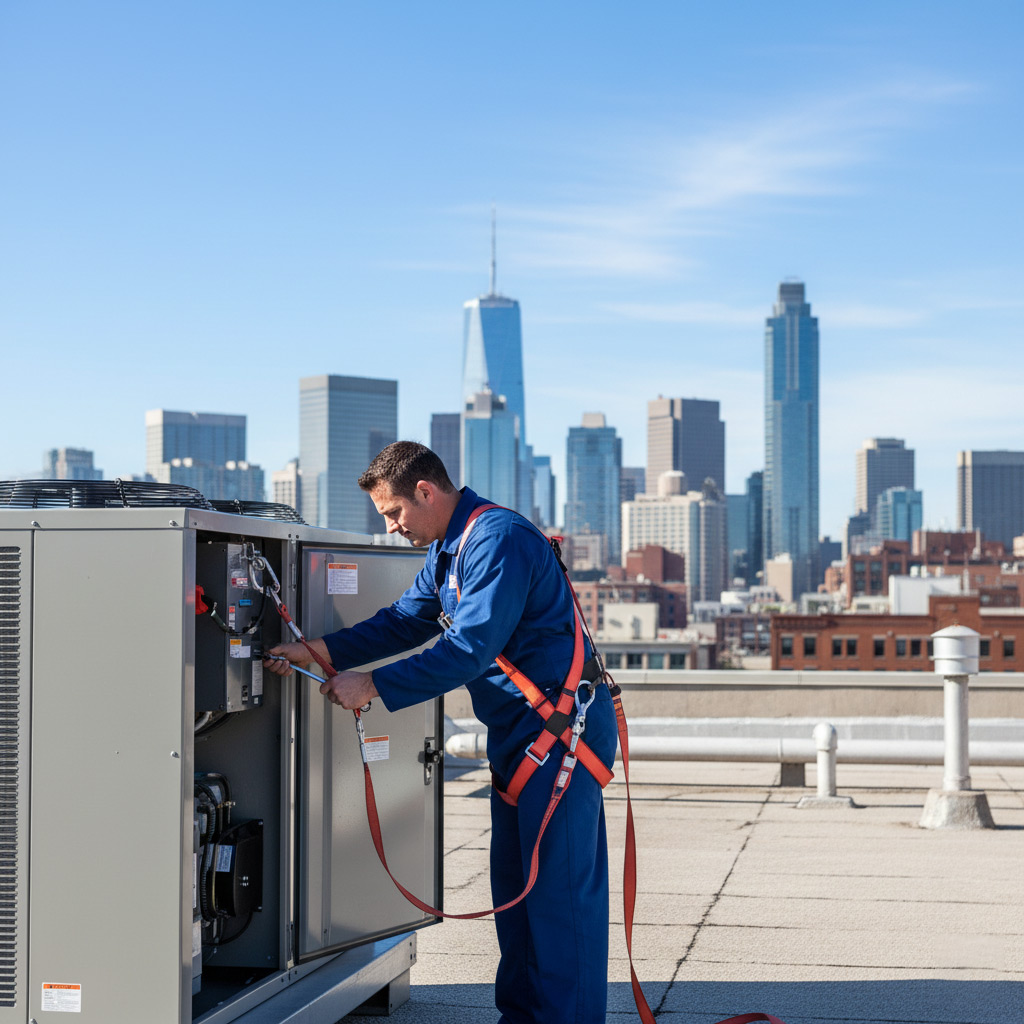
Let's be honest—most homeowners think this is the messy part. It's not. Professionals treat refrigerant recovery like a hazmat operation. They start by pumping every ounce of refrigerant out of your old system (illegal to vent it, plus they face $37,500 fines).
Here's what you should observe:
- Electrical disconnect happens immediately (safety first, always)
- The old unit gets wrapped in plastic before removal (no dirt tracked through your home)
- Every connection gets capped the moment lines are cut (sealed system integrity)
The condenser gets lifted off its pad. The indoor coil gets detached from your ductwork. By lunchtime, you're looking at empty spaces where your old equipment lived. The crew breaks for 20 minutes tops, and you notice they eat outside (they don't want crumbs in your workspace).
The Installation Window: Precision Over Speed
This is where most DIY attempts go nuclear. The new condenser gets positioned on a perfectly level pad (they use a laser level, not eyeballs). One degree off and your compressor shakes itself to death in 18 months. The installer beneath your house is welding copper lines with silver solder—he's got 2,100 hours of HVAC-specific training, not a YouTube tutorial.
Wiring gets pulled through liquid-tight conduit. A new disconnect switch gets mounted. The indoor unit gets lifted into place and connections get pressure-tested at 350 PSI for a full 60 minutes (federal code requires this—if they skip it, you've got amateurs).
- Ductwork inspection happens now (cracks get sealed with mastic, not duct tape)
- Insulation gets replaced where it's compressed
- Condensate lines get sloped 1/4 inch per foot minimum
The Final Two Hours: Testing and Training
You're watching the lead tech hook up digital gauges to your system. He's not guessing—he's measuring superheat, subcooling, and delta T. These numbers get written on your start-up report. If he can't show you the data, send him packing.
Your thermostat gets programmed. The system cycles through all modes (heat, cool, fan-only). Airflow gets measured at every register with an anemometer. They adjust dampers to balance the house. Then comes the crucial moment:
You get a 15-minute walkthrough of your system, including filter changes, breaker locations, and what to look for if something acts up. The best technicians will show you how to read your electrical meter so you can verify energy savings month one. That $6,500 investment becomes a working machine.
Case Study: How the Henderson Family Cut Their Energy Bills by 34% with a Properly Sized Trane System
Meet the Hendersons—a family of four living in a 2,100-square-foot ranch home just off Battleground Avenue. Last summer, their 18-year-old AC unit finally gave out during Greensboro's infamous July heatwave. They were quoted $4,200 for a new 4-ton unit from a door-to-door salesman who swore "bigger cools better." Thankfully, they got a second opinion.
HVAC expert Mike Torres performed a Manual J load calculation and discovered their home only needed a 2.5-ton Trane XR14 system. The old unit was 60% oversized, cycling on and off every 8 minutes and wasting enough electricity to power a small office building. The new properly sized system runs longer but uses less energy per hour, maintaining consistent humidity levels without the constant stop-start jolts.
Here's what changed in their first 90 days:
The Money in Their Pocket
- Electric bill dropped from $287/month to $189/month average
- Fewer breakdown calls—zero service issues in 6 months
- Home humidity stays at 45-50% instead of swinging between 30-65%
The real win came during September's heatwave when the system ran 18 hours straight but kept the house at 72°F without breaking a sweat. Their old unit would have tripped the breaker twice and cost them $400 in emergency repairs.
Final Thoughts: Your Next Move Before the Next Heat Wave Hits
Let’s be blunt. That old AC unit isn’t getting any younger, and Greensboro summers don’t play nice. Waiting until it quits on a Sunday afternoon in August isn’t a strategy. It’s a $500 hotel bill and a week of cold showers.
The smart move? Get proactive.
Start by grabbing last month’s energy bill. If you’re paying more than your neighbor for a similar-sized home, your system is begging for an upgrade. A new unit will save you money, run quieter, and keep your family comfortable when the temperature hits triple digits.
Here’s what to do this week.
- Call two reputable contractors from your research
- Ask for a free load calculation
- Compare quotes and warranties
An expert Air Conditioning Installation professional can spot issues you’ll never see. They’ll check ductwork, insulation, and airflow before suggesting the right system. This prevents buying a unit that’s too big or small.
Don’t put this off. Schedule a consultation today, before the next big heatwave turns your home into a greenhouse. Your wallet and your family will thank you when you’re cool and comfortable all season long.
People Also Ask
How much does AC installation cost in Greensboro, NC?
The average AC installation in Greensboro ranges from $5,000 to $12,000 depending on system type and home size. Central air systems typically cost $6,500-$10,000, while ductless mini-splits run $3,000-$8,000 per zone. Factors like existing ductwork, electrical upgrades, and energy efficiency ratings significantly impact final costs.What size AC unit do I need for a 2,000 sq ft home?
A 2,000 sq ft home typically requires a 3.5 to 4-ton AC unit, but proper sizing requires professional load calculations. HVAC contractors use Manual J calculations considering insulation, window orientation, and local climate—not just square footage. Undersized units struggle in peak heat, while oversized units short-cycle and waste energy.How long does AC installation take?
A standard central AC installation takes 6-10 hours for a professional crew, while ductless mini-split installations require 4-6 hours per indoor unit. Complex installations with ductwork modifications or electrical upgrades may take 2-3 days. The timeline includes removing old equipment, setting new units, connecting refrigerant lines, and final testing.Do I need a permit for AC installation in Greensboro?
Yes, Greensboro requires permits for AC installations and replacements, which your licensed contractor typically handles. Permits ensure installations meet local building codes and safety standards, and they're required for warranty validation. Working with unpermitted installations can void manufacturer warranties and create issues during home sales.What are the signs I need to replace my AC unit?
Replace your AC if it's over 10-15 years old, requires frequent repairs, or shows uneven cooling throughout your home. Other warning signs include rising energy bills, unusual noises, refrigerant leaks, and R-22 refrigerant use (phased out). New energy-efficient systems can reduce energy costs by 20-40% compared to older units.
Greensboro HVAC specializes in heating, ventilation, and air conditioning services for residential and commercial customers throughout Greensboro, North Carolina. The company's skilled technicians bring years of experience in HVAC installation, maintenance, and repair, ensuring optimal indoor comfort year-round. As a locally owned and operated business, Greensboro HVAC is committed to serving the community with reliable, professional service and prompt response times.
Need HVAC?
We deliver timely and effective solutions in Greensboro, NC and surrounding areas (27401, 27403, 27410) to help individuals and businesses achieve their goals quickly and efficiently, with a focus on driving results and enhancing productivity. Our services are designed to provide fast and reliable outcomes that meet the unique needs of our clients.
Request Detailed Quote